
Housing Is an Education Issue: Why One Arizona School District Is Taking a Stand
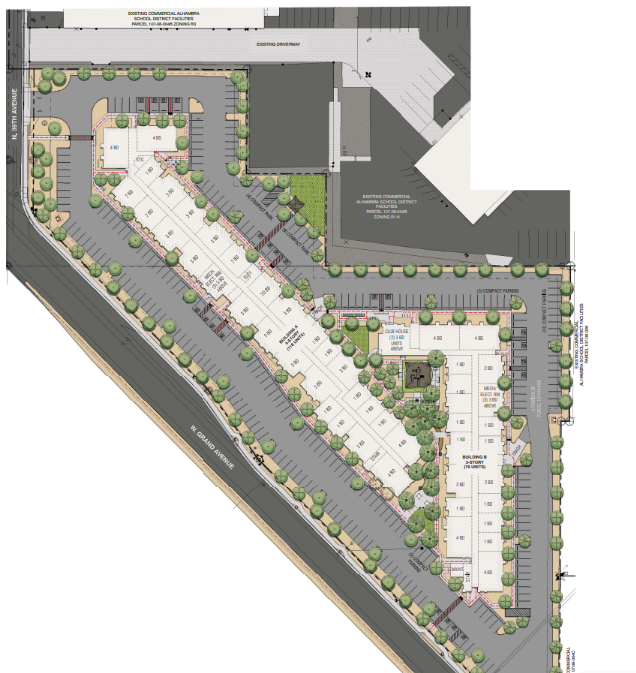
A rendering of Salamanca Square in Phoenix. (Courtesy of UMOM)
For decades, housing policy and education policy have largely operated in separate lanes. The state and individual cities make decisions about zoning and development, establishing housing programs and funding. School districts focus on educating students.
But for school districts serving communities facing a housing shortage, that separation is increasingly difficult to defend.
A family struggling to find an affordable home is not just experiencing a housing problem. Their children may face instability, frequent school changes, longer commutes, or homelessness. A teacher who cannot afford to live near the school where they work is not just experiencing a workforce problem.
These are educational challenges.
That reality is particularly clear in the Alhambra Elementary School District in Phoenix, which serves a community experiencing high rates of eviction and housing instability. We have seen dozens of families connected to our schools displaced from their homes because of eviction and rising housing costs.
When a family is forced out of their home, the effects do not stop at the front door. Children can be forced to change schools, lose connections with teachers and classmates, or face homelessness. For a school district, housing instability quickly becomes educational instability.
That is why I recently worked with my fellow governing board members to adopt a resolution formally recognizing housing stability as an educational issue and establishing a framework for the District to support housing policy and investment at the local, state, and federal levels.
Importantly, this resolution is not simply a statement of principles. The District is already putting these ideas into practice.
Salamanca Square: Putting Public Land to Work
The most tangible example is Salamanca Square, a 192-unit affordable housing community being developed in partnership with UMOM New Day Centers, a local nonprofit affordable housing provider. The District recently closed on the development, putting District-owned land toward an important community need: providing families with access to stable, affordable homes.
The connection to education is direct.
Affordable housing in the communities served by a school district can help families remain in their neighborhoods and maintain continuity for their children. For a district that has seen families displaced by eviction, creating new affordable housing is not an abstract exercise in land use. It is part of creating the conditions that allow students to remain stably housed and connected to their schools.
Salamanca Square also demonstrates why school districts should have a role in broader housing conversations. Districts understand the needs of the families they serve, own significant amounts of public land, and have a direct interest in the stability of their communities.
The project is not about turning every school property into housing. It is about recognizing that, where appropriate, underutilized public land can become an asset in addressing a community's housing needs.
A School District Supporting More Housing
The resolution goes beyond recognizing the connection between housing and education. It establishes a broad policy position in support of increasing housing opportunities.
That includes affordable housing, workforce and teacher housing, family-sized homes, mixed-income developments, permanent supportive housing, transitional and bridge housing, senior housing, and middle-housing types such as duplexes, triplexes, fourplexes, bungalow courts, and townhomes.
It also supports transit-oriented development and higher-density residential and mixed-use development.
Arizona's housing shortage cannot be solved with a single housing type or policy intervention. We need more homes at a variety of price points and in a variety of forms, preserving existing affordable housing while producing new affordable and market-rate housing and making it easier to add homes where infrastructure and services already exist.
From an urbanist perspective, this is fundamentally a question of housing abundance and choice.
Zoning Decisions Have Consequences for Schools
School districts may not write zoning codes, but zoning decisions directly affect the communities they serve.
When cities prohibit anything other than detached single-family homes across large portions of their residential land, limit the number of homes that can be built on a parcel, or require excessive amounts of parking, they constrain housing supply.
The same is true when communities make it unnecessarily difficult to convert existing buildings to housing, add accessory dwelling units, build infill development, or construct housing near transit.
The resolution therefore supports policies that reduce barriers to housing production and preservation, including:
Zoning and land-use reform;
Parking reform;
Transit-oriented development;
Adaptive reuse and infill development;
Streamlined permitting;
Middle-housing legalization; and
Public investment in affordable and workforce housing.
These policies are often discussed as urban planning issues. They are that—but they are also school issues.
A community that makes it easier to build housing can give more families the opportunity to remain in the neighborhoods where their children attend school. It can help educators live closer to their workplaces and create opportunities to locate housing near existing schools, transit, jobs, and other community infrastructure.
School Districts Have a Role to Play
School districts are major public landowners. As enrollment patterns and facility needs change, some properties may become underutilized.
That raises an important question:
Can some public land currently serving little or no educational purpose be put to work addressing the housing needs of the community?
Salamanca Square provides one answer.
The resolution directs District leadership to explore additional opportunities, when feasible and consistent with District priorities and legal requirements, to leverage underutilized District-owned land for affordable housing, workforce housing, teacher housing, or mixed-income developments.
This is not a mandate to turn school campuses into apartment buildings. It is an invitation to think creatively about public assets.
School districts can partner with nonprofit housing providers, municipalities, housing authorities, and private developers to create housing while advancing their own institutional goals. Depending on the project, those partnerships can provide housing for families and educators, generate revenue, support community stability, and put otherwise underutilized public assets back to work.
The experience with Salamanca Square demonstrates that these partnerships do not have to be theoretical.
Building Communities Where Families Can Stay
The underlying challenge is not unique to Alhambra, Phoenix, or Arizona. School districts across the country are confronting rising housing costs, teacher shortages, enrollment instability, and the consequences of housing insecurity.
These challenges intersect with decisions about housing, transportation, infrastructure, and economic development. The people making those decisions need to be talking to one another.
School districts should not become zoning authorities. But they should be recognized as important stakeholders in housing policy.
When a city considers allowing more homes near a school, a school district should understand why that matters. When a state considers investing in affordable housing, school leaders should be able to explain how housing stability affects their students. And when a district has surplus or underutilized property, it should be able to ask whether that land could help address a critical community need.
Ultimately, the resolution is about a simple idea: schools cannot thrive if the families and workers who make up their communities cannot afford to remain there.
In Alhambra, we have seen the consequences firsthand. When families are displaced through eviction, schools experience the ripple effects. Salamanca Square offers a different possibility: using public resources and cross-sector partnerships to create more affordable homes and give families a better chance to remain rooted in their communities.
If we want strong schools, we need stable families.
If we want stable families, we need housing people can afford.
And if we want communities where teachers, families, seniors, young people, and working households can all find a place to live, we need to build more housing and remove the barriers that stand in the way.
School districts may not be housing agencies, but they are deeply affected by housing policy and they can be powerful partners in building communities where families can afford to stay,
