
The Two-Staircase Rule Is Outdated. Here’s Why Phoenix Should Change It.
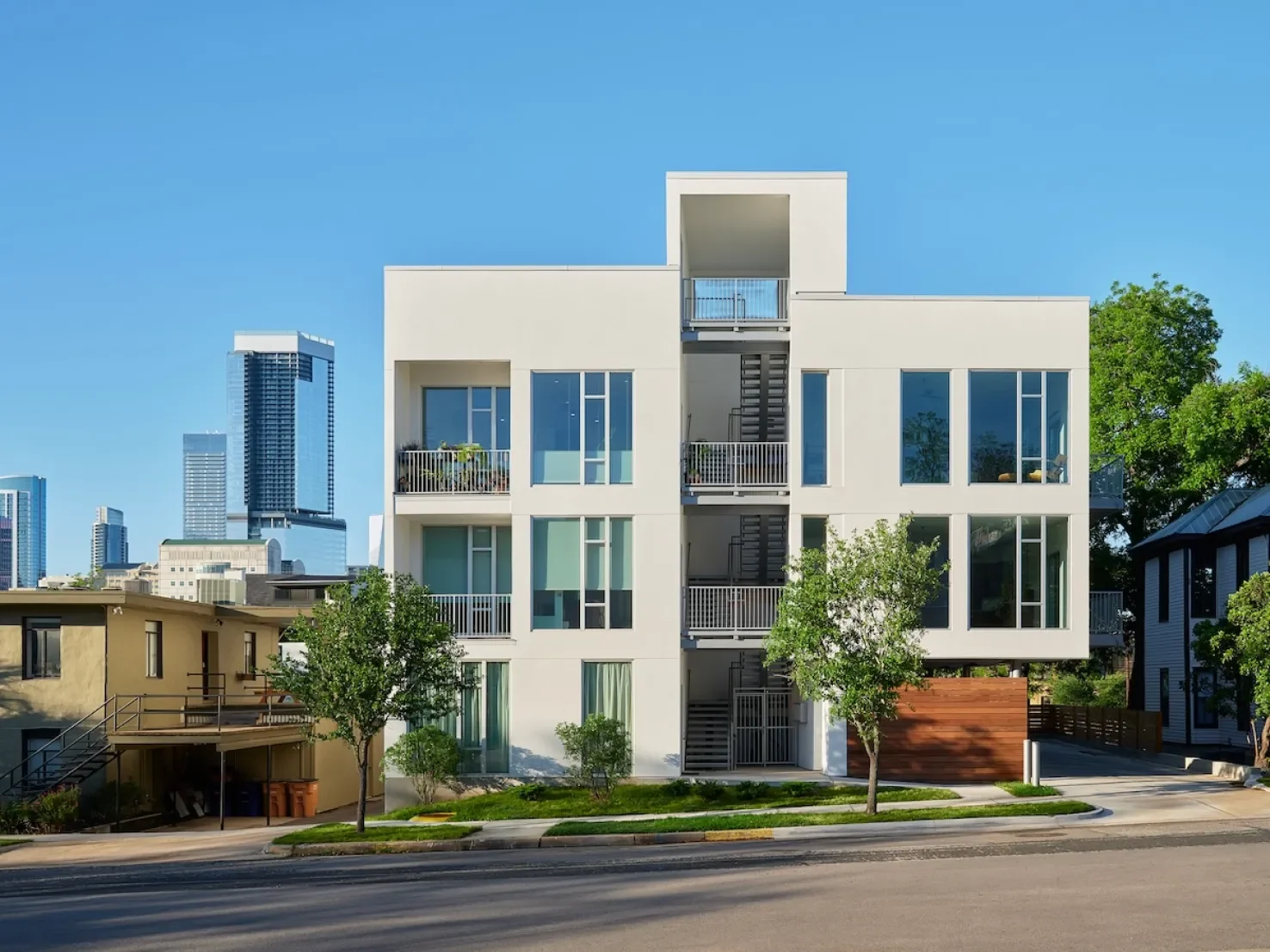
A proposed single-staircase infill development in Austin | McKinney York Architects / Ashram Multifamily
In nearly every American city, including Phoenix, an apartment building taller than three stories is required to have two separate staircases. The rule is rarely questioned. More exits sound like more safety. But a growing body of research, including the first-ever empirical analysis of fire deaths in single-stair buildings, points to a conclusion that runs against the intuition: modern single-stair buildings are at least as safe as two-stair buildings, and modern apartment buildings of all kinds are far safer than the single-family homes where most Americans live.
The two-staircase requirement is one of the quieter reasons mid-size apartment buildings are so hard to build on the small lots that define much of central Phoenix. Updating it would expand housing supply, lower construction costs, and support the city’s climate and infill goals, and it would not cost taxpayers anything.
Where the Two-Staircase Rule Came From
The requirement dates to a deadly tenement fire in New York in 1860, the era of the external metal fire escape (American Planning Association, 2025). It was written into the model codes long before modern fire protection existed: before sprinklers, smoke alarms, fire-rated wall assemblies, and self-closing doors became standard. In that context, a second staircase functioned as a backup if the first was blocked.
The International Building Code (IBC) that Phoenix adopts still sets the threshold at three stories. The buildings constructed today, however, bear little resemblance to the structures that prompted the rule. We are applying a nineteenth-century standard to twenty-first-century buildings.
The Fire Code Is Already More Permissive Than the Building Code
One detail tends to surprise people new to this issue. If a second staircase were a basic safety necessity, the fire-safety profession would be expected to hold the strictest line. It does not.
The NFPA 101 Life Safety Code, published by the National Fire Protection Association and referenced by fire marshals nationwide, has permitted single-stair apartment buildings up to four stories since its 1939 edition. That is one full story above what the IBC allows today, and it has been settled fire-safety practice for more than eighty years.
What the Evidence Shows
In 2025, The Pew Charitable Trusts and the Center for Building in North America published the first-ever analysis of fire-death rates in modern single-stair buildings, examining 347 fires and 468 deaths over a twelve-year period in New York City, the U.S. city with the most single-stair buildings.
The findings were consistent across every measure:
No elevated risk. From 2012 to 2024, fire-death rates in modern single-stair buildings as tall as six stories in New York City were no different from those in other residential buildings. The city has 4,440 such buildings (Pew Charitable Trusts, 2025).
Zero deaths attributable to the missing stair. Across New York City and Seattle combined over the same period, four fire deaths total occurred in modern single-stair buildings. Each was investigated, and in none did the absence of a second staircase play any role. In every case the fire stayed within the apartment where it began and never reached the stairway or even the corridor, so the deaths occurred in the unit of origin, where a second staircase would have made no difference. Three of those deaths were in two separate New York City fires, and one was in Seattle.
Consistent internationally. In the Netherlands, where single-stair construction is common, the fire-death rate in single-stair buildings is on par with other residential building types.
Modern Apartments Are Safer Than the Housing Most Phoenicians Live In
The more significant finding reverses the conventional assumption entirely.
For its 2025 report, Pew tracked every publicly reported residential fire death in the United States in 2023. The annual fire-fatality rate in apartments built since 2000 was 1.2 deaths per million residents, compared with 7.6 in single-family homes and 7.7 in apartment buildings built before 2000. Modern multifamily housing carries a fire-death rate roughly one-sixth that of single-family homes and older apartments.
The scale is striking. Of the roughly 8.3 million Americans living in apartments built since 2010, four died in a residential fire in 2023. At least twenty died that same year in fires related to homelessness.
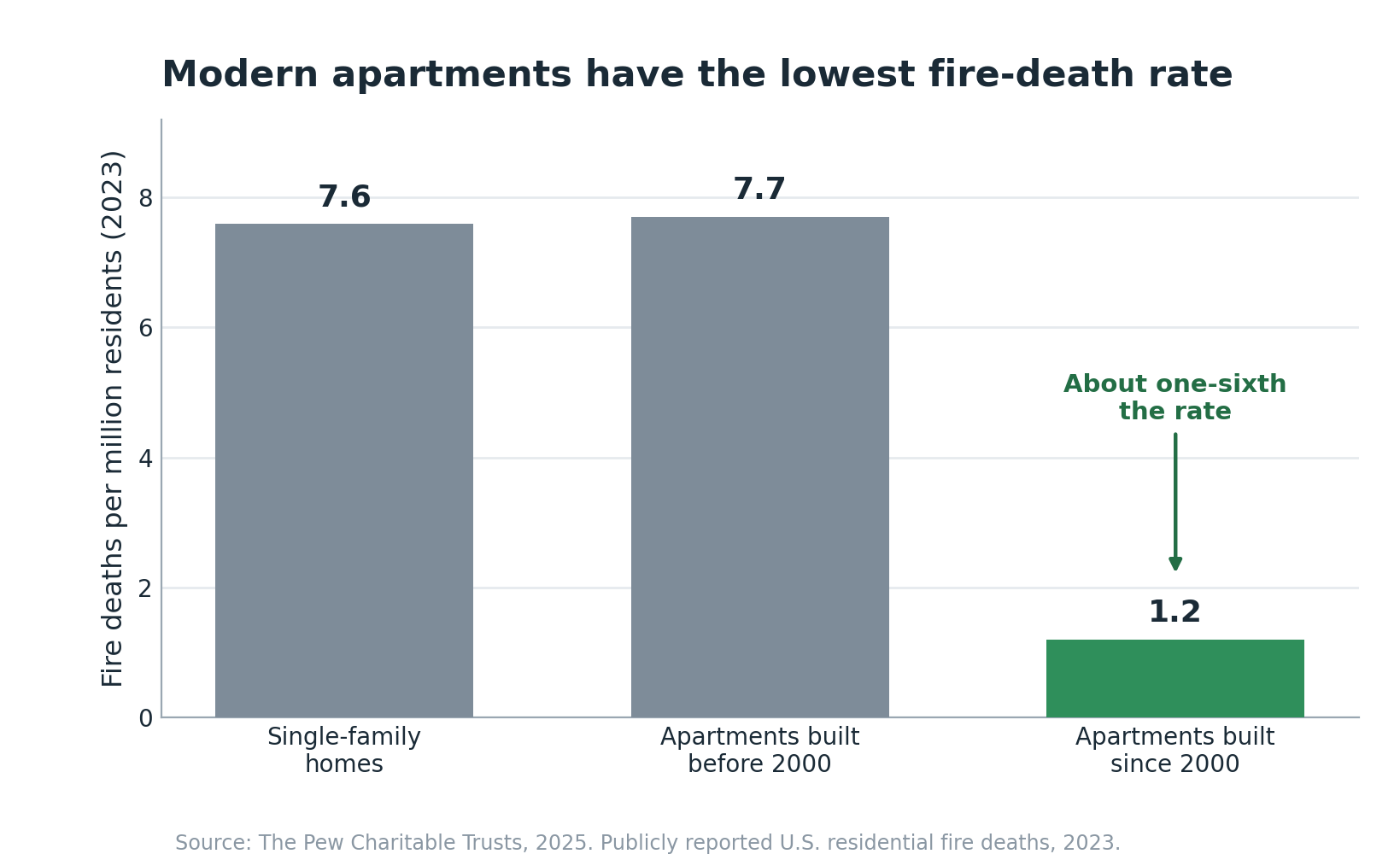
Fire deaths per million residents by housing type, 2023.
Apartments built since 2000 have roughly one-sixth the fire-death rate of single-family homes and older apartment buildings.
Source: The Pew Charitable Trusts, 2025.
The reason is construction. Sprinklers, fire-rated walls, self-closing doors, fire-resistant materials, and smoke alarms work together to contain a fire to its unit of origin and to give residents time to leave. A single-stair building permitted under a modern reform includes all of these features. They accomplish what the second staircase was intended to do, and they do it more effectively. Fire-engineering research has found that single-stair buildings up to eight stories evacuate faster than large double-loaded two-stair buildings, because residents are closer to a single well-marked exit and fewer people share each stairwell (Pew Charitable Trusts, 2025). The single-stair model keeps every unit door within roughly 20 feet of the protected stairway, with total travel distance capped near 125 feet. The double-loaded corridors typical of large apartment buildings, by contrast, can place a unit as much as 250 feet from the nearest exit. In other words, residents of the large complexes the current code favors are often farther from a stairway than they would be in a single-stair building.
There is a final implication worth stating plainly. Roughly 93% of American homes are not modern multifamily buildings. Each time the two-staircase rule prevents a modern apartment building from being built, and the housing instead takes the form of a single-family home or an older structure, the rule steers people toward housing with a worse fire record. A standard written to protect public safety produces a less safe result.
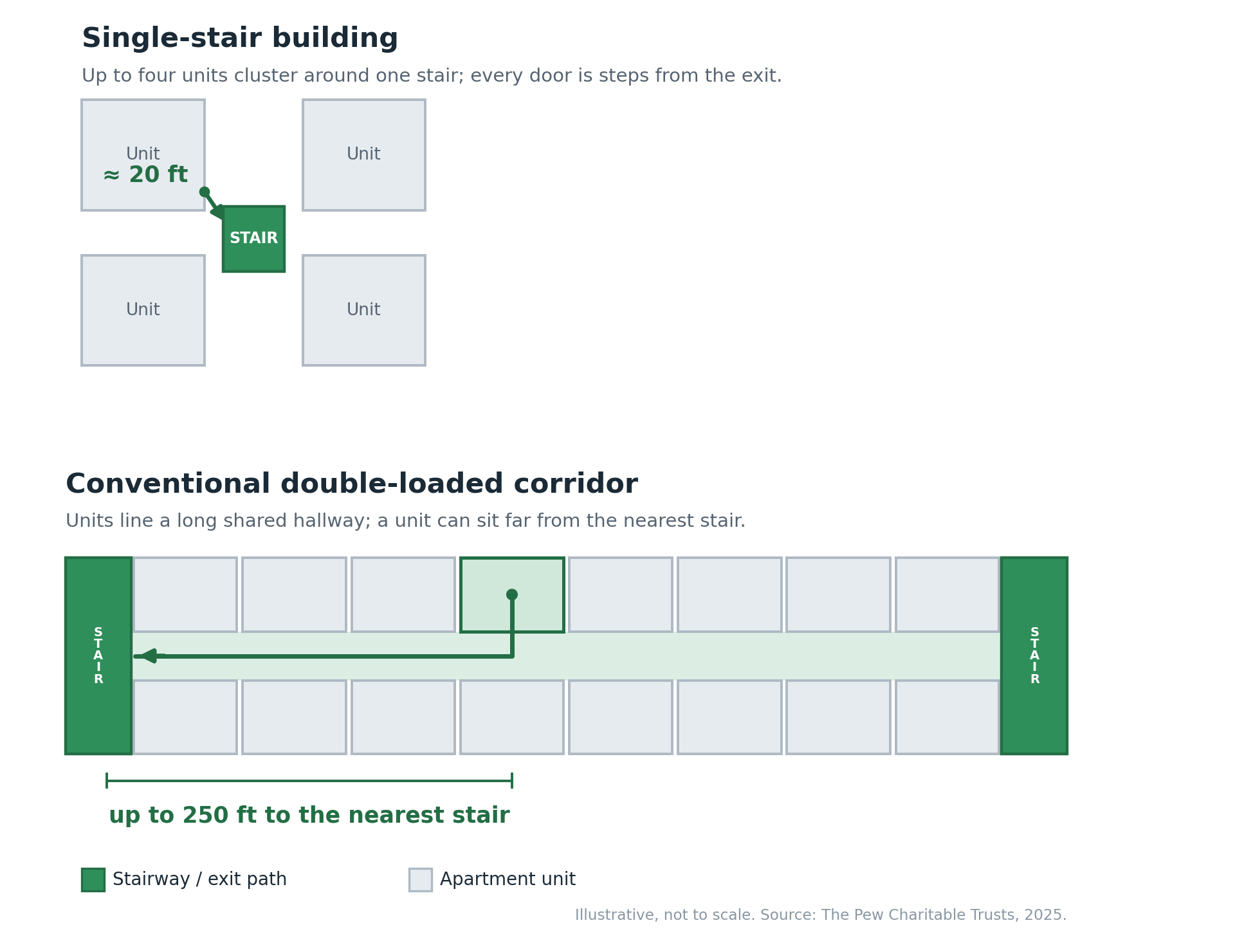
How far a resident may have to travel to reach a stairway.
A single-stair layout keeps every door close to the exit, while a conventional double-loaded corridor can leave a unit far from any stair. Illustrative, not to scale. Source: The Pew Charitable Trusts, 2025.
What the Rule Costs Phoenix
Setting fire safety aside, the requirement carries real costs for housing supply and design.
To justify a second staircase and the corridor that connects it, a project needs a large floor plate, which in turn requires a large lot. That single requirement shapes the kind of housing Phoenix gets. It pushes developers to assemble several parcels into one big site, which is a major reason so much recent construction takes the form of large, uniform complexes that fill an entire block, the building type many residents associate with generic, corporate development. At the same time, it leaves the small, narrow, and irregular vacant lots scattered throughout central Phoenix sitting empty, because a mid-rise building on them frequently cannot be made feasible under the two-staircase rule. What does get built relies on the double-loaded corridor: two rows of units flanking an interior hallway, with most apartments facing a single direction and limited cross-ventilation.
Single-stair design changes that calculus. Clustering up to four units per floor around one staircase yields a compact building that fits on a single small or vacant lot, with no parcel assembly and no full-block footprint required. The result is apartments with windows on multiple walls, genuine cross-ventilation, and larger, more family-sized units, in buildings scaled to the neighborhoods around them rather than looming over them. In a city where summer cooling drives household energy costs, that ventilation is a meaningful benefit, not an amenity. Research also indicates thatadding a second staircase raises construction costs by 6 to 13 percent, which on a constrained infill project is often the margin between a project that proceeds and one that does not.
A More Walkable Phoenix
Walkability is central to what makes a neighborhood livable, and single-stair reform supports it directly. Because these buildings fit on small infill and vacant lots inside neighborhoods that already exist, they add homes within walking distance of the shops, restaurants, transit stops, and jobs that are already there. That is the reverse of the conventional pattern, in which new housing is pushed to the edges of the region and nearly every errand requires a car.
More residents on these lots also means more customers for local businesses and more riders for the transit Phoenix is investing in, which is how walkable commercial districts sustain themselves. Distributing modest, well-scaled buildings across many neighborhoods, rather than concentrating growth in a handful of large complexes, extends those benefits more broadly. For a city working toward its Vision Zero, Climate Action Plan, and transit goals, putting more homes where people can comfortably walk, bike, and ride is among the clearest wins single-stair reform offers, and it lowers household transportation costs in the process.
Addressing Concerns from the Fire Service
Some fire officials have raised concerns, and those concerns merit a substantive response rather than dismissal. They center on maintaining active fire-protection systems, keeping stairwells clear of strollers, e-bikes, and stored items, ensuring adequate water supply, and providing departments with sufficient staffing and equipment.
The most specific objection from the fire service is that a single stair eliminates the option of designating one stairway for residents to evacuate and another for firefighters to attack the fire. In practice, that separation is difficult to achieve and is not guaranteed even in two-stair buildings. Both stairways are resident egress paths, and reserving one strictly for firefighters would force half the units onto a much longer exit route. Real fires bear this out: in incidents where one of two stairwells filled with smoke early, the remaining stair has had to serve both evacuation and fire attack regardless of the building’s design. Single-stair buildings address the underlying goal through their small scale instead. With a maximum of four units per floor, roughly twenty units in the entire building, full sprinklering, and an enclosed, smoke-protected stairway that every unit door sits within about 20 feet of, the number of people relying on that stair stays low and their path to it stays short.
These concerns are legitimate and addressable, and the states that enacted single-stair reform in 2025 addressed them by working with their fire services rather than around them. Colorado consulted fire-prevention specialists and amended its bill roughly two dozen times before passage.New Hampshireamended its legislation specifically to resolve State Fire Marshal concerns. A durable single-stair code is built in partnership with the fire department.
What Other Cities and States Are Doing
Single-stair reform is no longer an outlier position. Several jurisdictions have allowed these buildings for decades, and momentum accelerated sharply in 2025:
Seattle has permitted single-stair buildings for nearly fifty years, and New York City and Honolulu allow them up to six stories.
In 2025, four states enacted single-stair legislation: Colorado, Montana, Texas, and New Hampshire, with Maine in process and Hawaii and Maryland convening study groups.
Austin adopted a local ordinance in the spring of 2025 allowing single-stair buildings up to five stories.
Denver passed its own ordinance in November 2025 and estimated that nearly 39,000 parcels in the city could support a single-stair building under the new rules.
Austin and Denver are both useful comparisons for Phoenix: fast-growing cities facing similar housing-affordability pressures, and both acted through a local ordinance, the same path available to Phoenix. There is every reason for Phoenix to be among the cities acting on this rather than watching from the sidelines.
How Phoenix Can Make This Change
Single-stair reform is a building-code change, not a zoning change, so it does not require a zoning text amendment or a General Plan revision. Phoenix updates its construction code through the Planning and Development Department in partnership with the Development Advisory Board (DAB), the body charged with reviewing code amendments before they reach City Council. A targeted amendment would not need to wait for a full code cycle.
The parameters that other jurisdictions have converged on are consistent and well-tested: five to six stories served by a single staircase, a maximum of four units per floor, sprinklers throughout, fire-rated stair and corridor construction, and a short, capped travel distance from each unit door to the stairway. Phoenix should not settle for a more cautious four-story cap. Seattle has permitted single-stair buildings up to six stories for decades, and Montana and Texas both authorized six stories in their 2025 laws.
What keeps these buildings safe is not the number of stairways but the layered protections the model requires: sprinklers on every floor and at every landing, fire-rated assemblies around the stairway and between units, a short and capped travel distance to the exit, a protected stair enclosure, and the four-unit-per-floor limit that holds down the number of people depending on that single stair. A six-story building also remains within reach of fire department aerial ladder access. With those measures in place, the fifth and sixth floors carry no greater fire risk than the floors below them. Seattle’s fifty-year record and the 2025 state statutes give Phoenix vetted language to adapt rather than draft from scratch.
A Valley-Wide Opportunity
The case for single-stair reform is not limited to Phoenix. The same small-lot math applies across the Valley, and for some cities the land constraint is even sharper.
Tempe is the clearest example. The city is effectively landlocked, surrounded by Phoenix, Scottsdale, Mesa, Chandler, and Guadalupe, with no ability to annex land or expand its borders. Tempe cannot build out, so its only path to additional housing is to build up and in. Single-stair design is tailor-made for the kind of small, irregular infill parcels that make up much of the land Tempe has left, and it would let the city add mid-rise housing without the large floor plates the two-staircase rule demands.
Even Valley cities with more room to grow stand to gain. Mesa has invested heavily in light rail along Main Street and continues to pursue transit-oriented development in and around its downtown. Single-stair construction would make mid-rise housing near those stations far more feasible on the constrained downtown lots where the city most wants density, rather than pushing growth to the far edges of the region. The same logic extends to Scottsdale, Glendale, Chandler, and Gilbert, each of which faces its own infill and build-out pressures as undeveloped land grows scarce and expensive.
Because Arizona is a home-rule state, each city adopts and amends its own building code, which means any Valley city can act on single-stair reform independently. It also means a single statewide enabling law, like the approaches Texas and Colorado took in 2025, could allow cities across the region to permit these buildings at once. Either path is open. What matters is that the Valley’s most land-constrained communities are precisely the ones with the most to gain.
Looking Ahead
Single-stair reform is not a complete solution to Phoenix’s housing shortage, and it should not be presented as one. It belongs alongside the other infill tools the city is weighing, including accessory dwelling units, parking reform, and middle housing. Each makes a small or irregular lots incrementally more buildable. Together, they are how Phoenix can add housing on the land it already has, near jobs and transit, without new public spending.
The two-staircase requirement was a reasonable response to the building conditions of 1860. The evidence available today, on fire safety, construction cost, and housing design, no longer supports it for modern mid-rise buildings. Phoenix’s building code should reflect the buildings, and the data, of the present.